Providers
Use LGF to offer and operate platform services with consistent lifecycle governance.

Provider operations can stay consistent across data centers, regions, and managed environments.
Use LGF to offer and operate platform services with consistent lifecycle governance.
Provider operations can stay consistent across data centers, regions, and managed environments.
LGF helps providers standardize operations while expanding service delivery. It supports provider-controlled mobility where providers choose to expose it.
Run different platforms with one consistent lifecycle and governance model.
Deliver more predictable customer support by reducing platform-specific operational divergence.
Train teams on shared workflows instead of rebuilding expertise per platform stack.
Bring new platform offerings online with less operational reinvention.
LGF supports workload portability and consistent recovery, but providers decide how those capabilities are packaged and exposed. A provider may use LGF to move customer environments between datacenters, support regional hosting, simplify disaster recovery, enable sub-provider services, or offer controlled migration options without making customer exit the default product behavior.
Expose movement only where it fits the provider's service model and support policy.
Keep one operational model across hosted, hybrid, and customer-facing offerings.
Support downstream providers, sub-providers, and partner-delivered services on provider-owned infrastructure.
Use the same governance for recovery, regional relocation, and managed transfer workflows.
Offer, onboard, provision, and manage customer-facing platform benches through one portal experience.
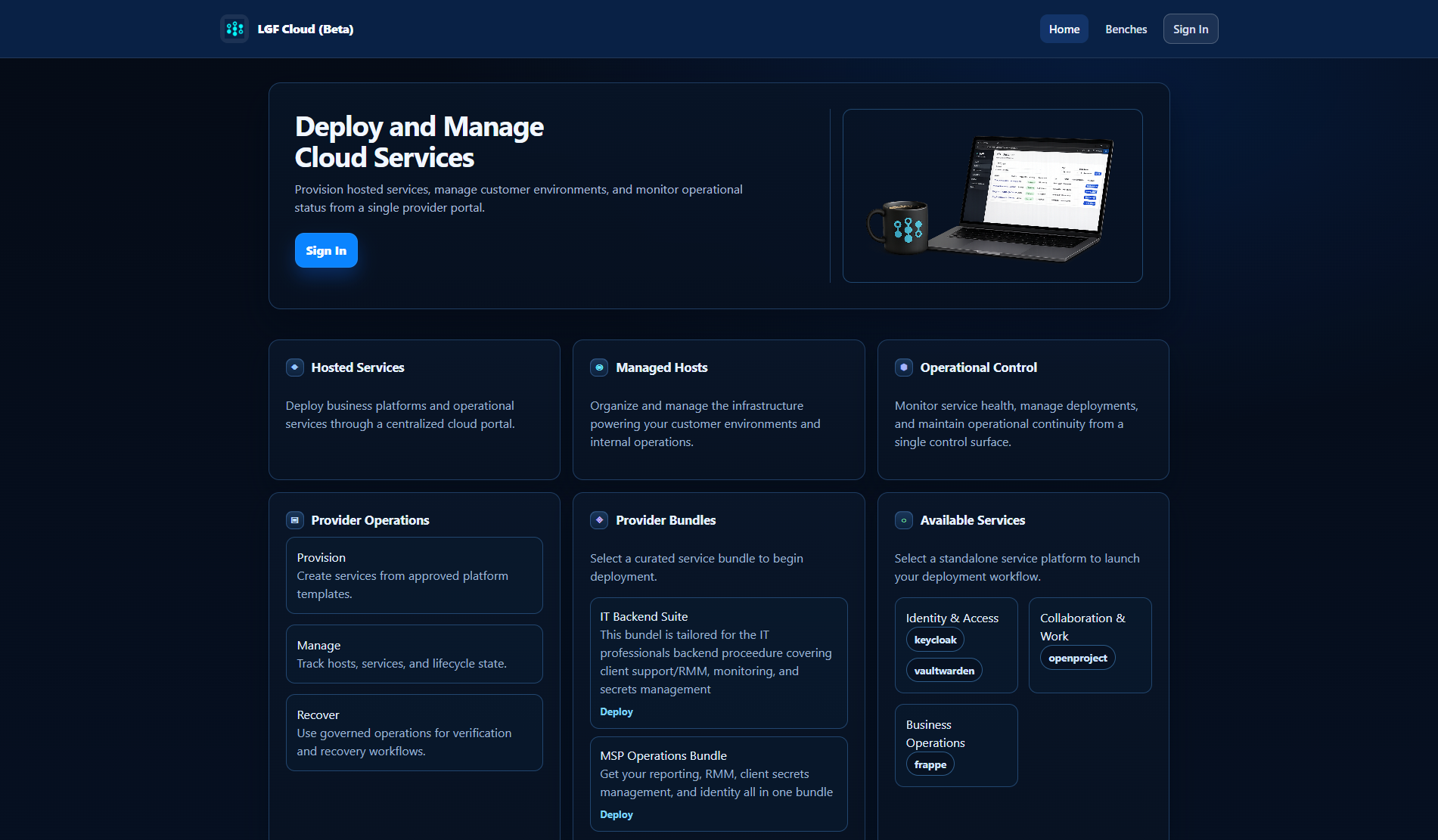
Provider-facing bench catalog, purchase routing, and operational controls.
Guide customers from account setup into service selection and controlled provisioning.
Present provider-approved platform offerings through clear catalog and bundle structures.
Trigger governed bench deployment workflows without exposing raw operational complexity.
Maintain host coordination, lifecycle visibility, and service continuity from one control surface.
Offer additional platform classes without multiplying operational complexity.
Maintain continuity through governed lifecycle, repair, and recovery workflows.
Support workload movement when hosting, compliance, or customer requirements change.
Reduce duplicated procedures and keep delivery models aligned across offerings.
LGF supports distributed provider ecosystems while preserving independent provider operations and commercial policy control.
Providers operate their own environments and service catalogs with local governance control.
Providers can present and deliver services through their own customer-facing operational portals.
LGF architecture supports broader distributed service ecosystems without requiring a single hosting authority.
Portal workflows provide the practical bridge between commercial delivery and governed operations.
Resolve drift and degraded state through governed workflows instead of bespoke emergency procedures.
Restore customer benches with repeatable workflows that reduce outage unpredictability.
Move workloads as business realities change while preserving support continuity.
Keep day-2 operations aligned across workloads, teams, and customer environments.