Business Operations
Integrated operational systems for ERP, HR, support, and telephony workflows.
Frappe / ERPNext
Business application platform based on Frappe Framework.
LGF standardizes how business platforms are deployed, governed, repaired, moved, and operated.
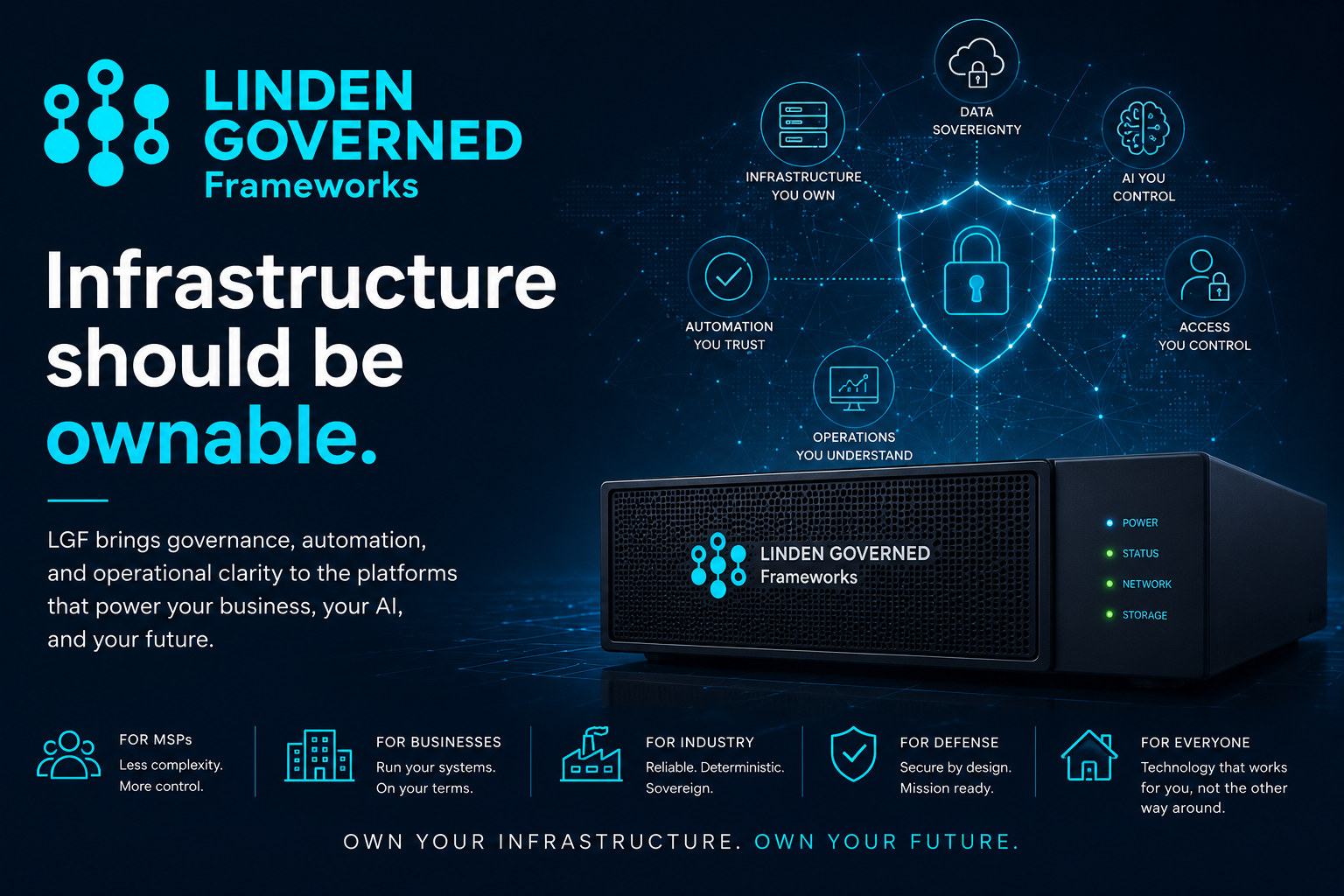
Infrastructure should be ownable, governed, and operationally predictable.
LGF supports multiple platform classes through one operational model. Development-marked items below are labeled Coming Soon.
A bench is a complete governed platform deployment, not just an app instance.
Each bench carries declared configuration, runtime expectations, and lifecycle intent.
Benches are operated through governed workflows for deploy, verify, repair, backup, restore, and update.
Benches can be moved or restored while preserving operational behavior and support boundaries.
Declared contracts define what a bench is allowed to do and how it is operated over time.
LGF treats lifecycle as governed operations, not manual administrator routines.
Initialize a bench into known-good operational state through declared inputs and controlled execution.
Confirm drift boundaries, runtime expectations, and declared artifact state before operating changes.
Reconcile invalid or drifted state through governed repair workflows rather than one-off fixes.
Capture recoverable bench state as part of continuity workflows, not as optional ad-hoc actions.
Return benches to known-good state with repeatable restore workflows and explicit operational control.
Apply framework and library evolution through controlled change paths with verifiable outcomes.
Decommission benches through governed procedures that preserve operational traceability and handoff clarity.
This is the current platform catalog LGF is validating across business operations, development, identity, collaboration, AI, infrastructure, creative, and delivery workloads.
Integrated operational systems for ERP, HR, support, and telephony workflows.
Business application platform based on Frappe Framework.
Self-hosted software lifecycle and CI/CD infrastructure.

LGF-governed control-plane bench for app deployment, ingress, and lifecycle automation.
Self-hosted source control, issues, and CI/CD platform.

Private PostgreSQL bench with pgAdmin access for application data.
Centralized authentication, identity federation, and credential management.
SSO, identity federation, and access control.
Self-hosted password manager for private credential storage.
Private local AI infrastructure with self-hosted inference and operator-controlled interfaces.

Local model runtime and inference stack with multiple deployment modes.
Self-hosted operational coordination and collaboration platforms.

Team collaboration platform with PostgreSQL backend.
Private file sync and collaborative workspace platform.

All-in-One Nextcloud deployment with managed capability controls.
Project planning and operational coordination.
Game servers and other operator-managed entertainment workloads.

Single-instance dedicated server with UDP ingress through LGF.

UDP-first dedicated server with LGF-managed port allocation.
Operational infrastructure management and remote systems administration.

Fleet inventory and orchestration UI for LGF appliances.

Endpoint visibility and device-management server.
Remote systems management and support platform.

Self-hosted monitoring for websites and services.
Distributed rendering and asset orchestration workflows for creative production environments.

MinIO asset plane, Flamenco manager/worker, and Blender workers.

Distributed render job orchestration for Blender workloads.

GPU-accelerated rendering engine for production scenes.
S3-compatible object storage for render assets and outputs.
Asset archival, indexing, and media management workflows.
Digital asset management and archival platform.
Provider-facing platform delivery and customer portal operations.

Customer-facing LGF Cloud Portal bench for provider delivery.
Installed libraries not yet assigned to a category.

Keygen Community Edition licensing API.
Development-marked items are labeled Coming Soon. LGF is not directly associated with platform vendors. Logos and trademarks are the property of their respective owners and do not imply affiliation, partnership, or endorsement.
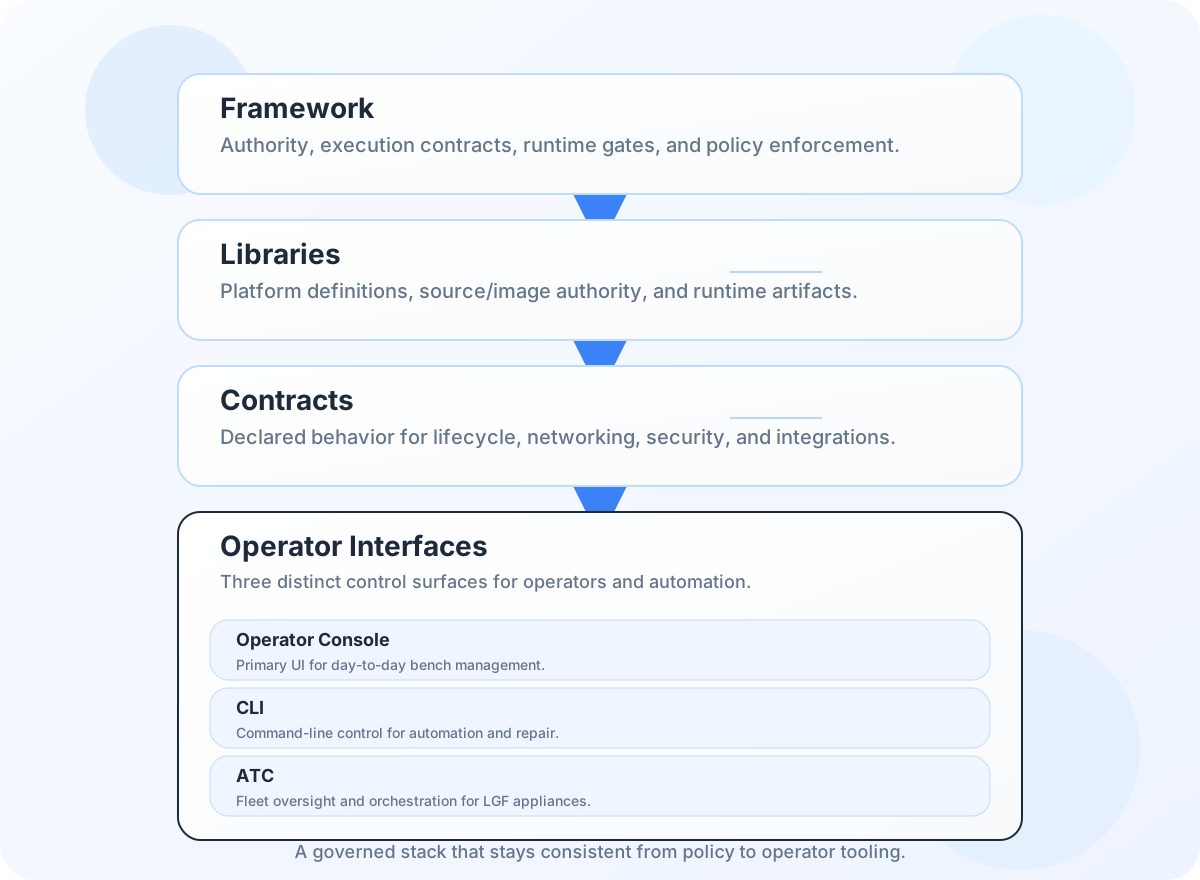
LGF uses a governed stack that flows from framework authority through libraries and contracts to operator tooling.
Portability is an operational capability governed by policy. LGF makes movement technically repeatable, while organizational policy determines when, where, and how movement is allowed.
Control how platforms are hosted, moved, and supported according to provider policy.
Support cloud-only, provider-hosted, hybrid, on-prem, regional, and partner-delivered models.
Support residency and jurisdiction requirements through controlled workload movement.
Move predictable workloads to environments that better align with provider capacity and business planning.
Preserve support continuity during mergers, datacenter shifts, and customer environment changes.