About LGF
A governed framework for provider-operated platform delivery.
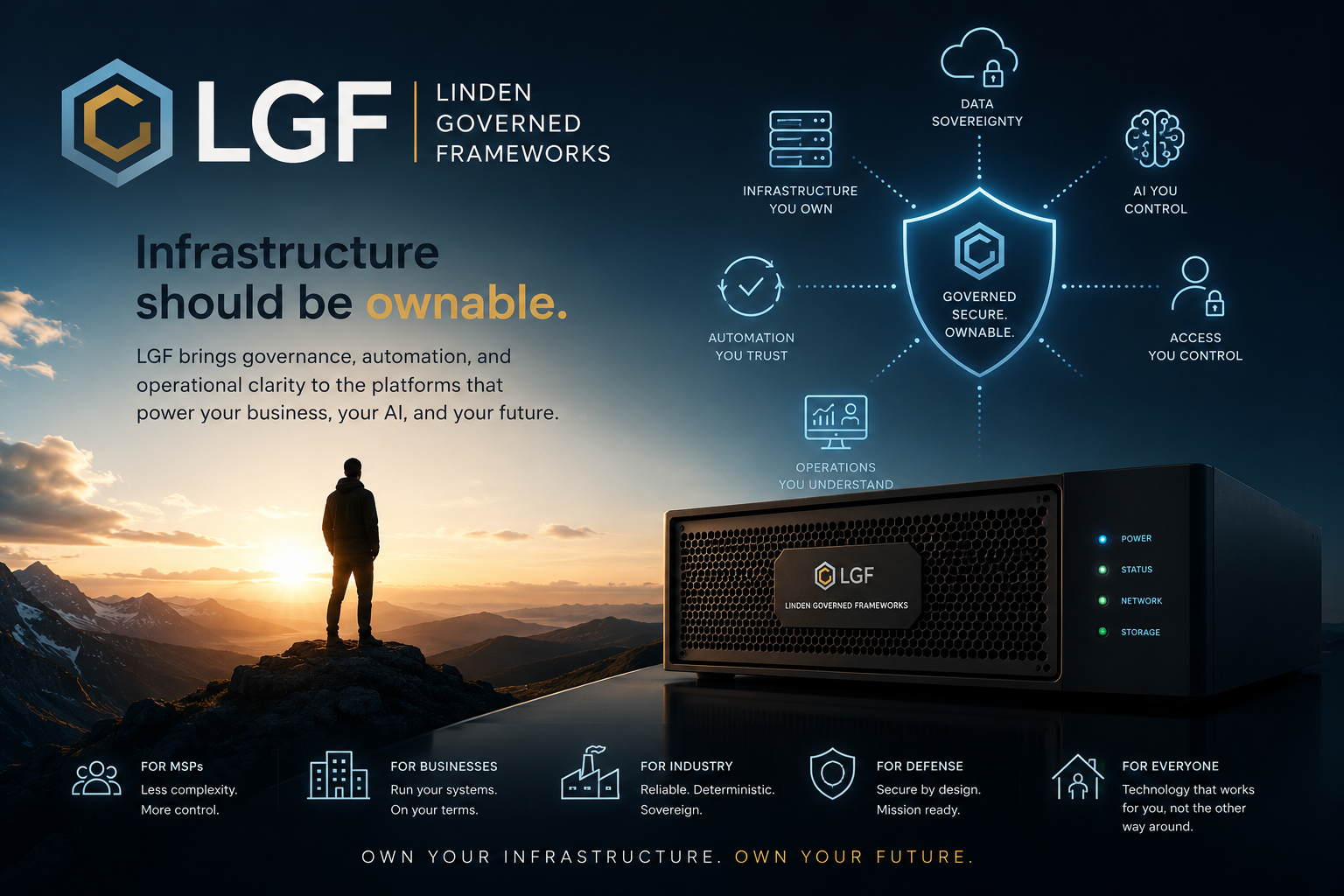
LGF exists to make infrastructure feel owned, understandable, and controllable.
A governed framework for provider-operated platform delivery.
LGF exists to make infrastructure feel owned, understandable, and controllable.
Modern business platforms are increasingly fragmented. Many organizations spend more time managing infrastructure complexity than operating the platforms that run their business.
LGF was created to simplify platform delivery through governance, consistency, recoverability, and controlled mobility.
Reduce variability across platform types by standardizing lifecycle workflows.
Restore and reconcile workloads through governed, deterministic operations.
Support commercial platform delivery without rebuilding operations per service.
Move workloads as business requirements change without losing operational control.
LGF is opinionated about operational governance, repeatability, and support consistency. It is not opinionated about whether a platform should be cloud-hosted, on-prem, provider-owned, customer-owned, hybrid, or partner-delivered. The framework creates controlled capability; the operator defines the business policy.
LGF standardizes delivery, recovery, and movement without dictating commercial policy.
Providers decide how mobility is offered, restricted, packaged, and supported.
The same framework can support cloud-only, provider-hosted, hybrid, regional, and partner-delivered models.
Portability is a capability to be governed, not a requirement imposed on every deployment.
Workloads and operational outcomes can remain customer-governed where that is the chosen policy.
Providers can adapt delivery environments without rebuilding their operating model.
Organizations keep practical control over where workloads run and how they are recovered.
Teams can run lifecycle workflows consistently without hidden platform dependencies.
LGF is intended as a framework for platform delivery and operations across providers, MSPs, operators, and organizations.
It is not positioned as ERP software, a cloud provider, or a hosting company. It is a governed operational framework for delivering and managing platforms consistently.
LGF is developed by Linden Infrastructure Labs to support governed platform delivery for operators, MSPs, and cloud providers.
Founder-led platform development with focus on practical infrastructure operations, lifecycle discipline, and reduced operational complexity.
LGF is shaped by hands-on infrastructure operations experience and built to reduce recurring delivery and support complexity in real production environments.